Check for safety
Make sure the area is safe before approaching the person.
Learn the basics
A practical CPR reference page with simple steps, official awareness material, trusted learning links, and the existing research citations below.
Giving CPR - 6 Simple Steps
Use this as a learning structure for awareness. In a real emergency, call local emergency services immediately and follow trained medical or dispatcher guidance.
Make sure the area is safe before approaching the person.
Tap and shout. Check if the person responds and is breathing normally.
Call emergency services and ask someone to bring an AED, if available.
Place the person on a firm, flat surface. Give 30 compressions in the center of the chest at 100-120 compressions per minute.
Open the airway using the head-tilt/chin-lift technique. Give 2 breaths, about 1 second each, watching for the chest to rise.
Repeat cycles of 30 compressions + 2 breaths. Use an AED as soon as available and minimize interruptions.
Note: For Hands-Only CPR training, Steps 5-6 should be adjusted because Hands-Only CPR generally focuses on continuous chest compressions without rescue breaths.
Official Awareness Resource
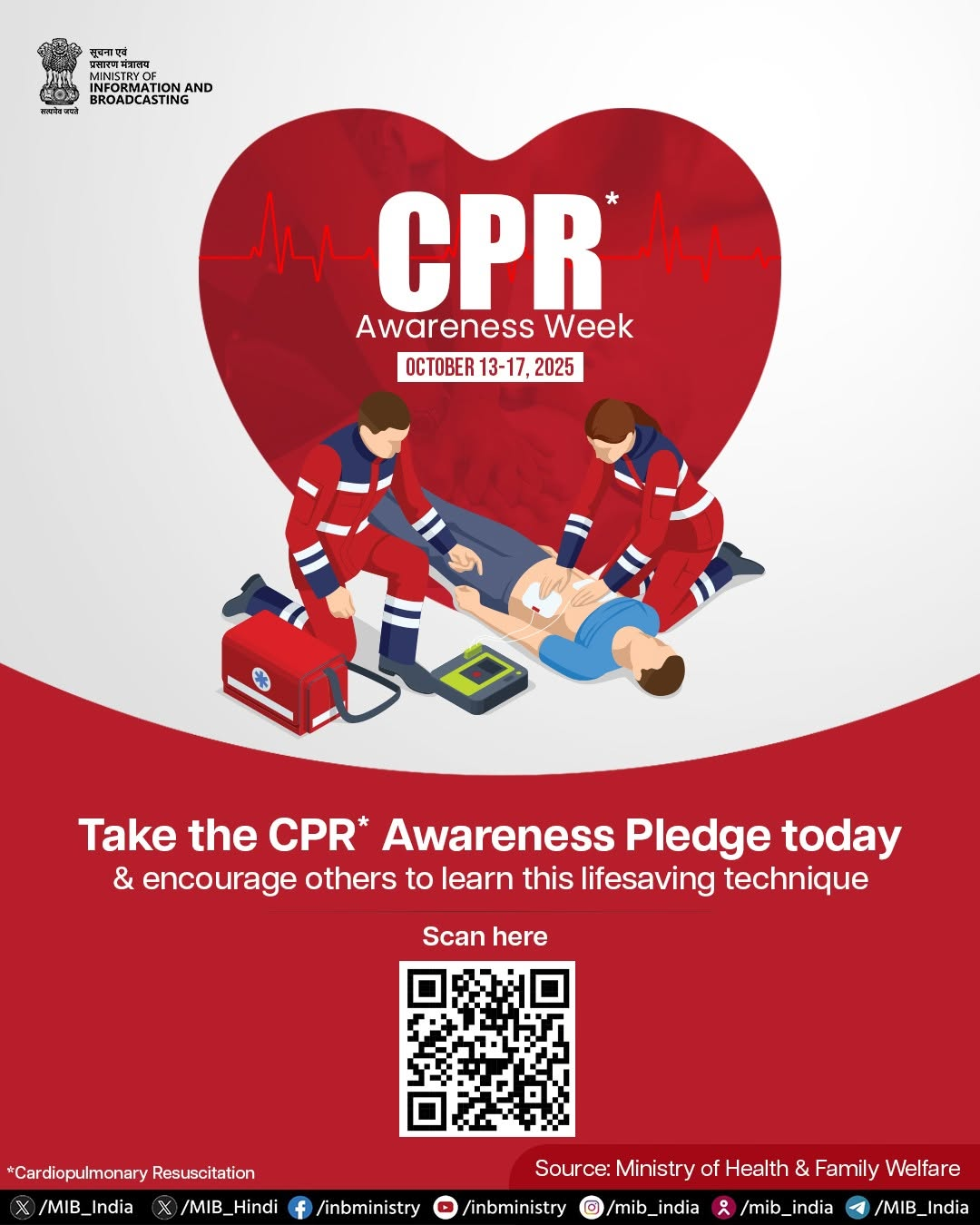
Cardiopulmonary Resuscitation (CPR) is a lifesaving and vital emergency procedure which improves the survival chances in critical cardiac cases. Take the CPR Awareness pledge today and encourage others to learn this essential skill.
Learning links
Cardiopulmonary Resuscitation (CPR) is a lifesaving and vital emergency procedure which improves survival chances in critical cardiac cases.
https://pledge.mygov.in/save-a-life-cpr/Official CPR Awareness Week post shared by the Govt. of India.
https://www.facebook.com/inbministry/posts/cardiopulmonary-resuscitation-cpr-is-a-lifesaving-and-vital-emergency-procedure-/1254084096752343/Adult CPR steps from the American Red Cross.
https://www.redcross.org/take-a-class/cpr/performing-cpr/cpr-stepsNHS guidance for CPR and first aid.
https://www.nhs.uk/tests-and-treatments/first-aid/cpr/Existing research moved below
These are the previous citations used across Start a Heart, kept below the CPR learning resources.
[1] Less than 2% of Indians know CPR.
-> Indian Heart Rhythm Society / PubMed Central - Sudden Cardiac Death in India - https://pmc.ncbi.nlm.nih.gov/articles/PMC10353589/[2] In India, about 3 sudden cardiac deaths happen every 10 minutes, based on an estimated 428,000 sudden cardiac deaths per year.
-> Estimated SCD burden, India - PubMed Central - https://pmc.ncbi.nlm.nih.gov/articles/PMC10353589/[3] Cardiac arrest claims more lives than colorectal cancer, breast cancer, prostate cancer, influenza, pneumonia, auto accidents, HIV, firearms and house fires combined.
-> American Heart Association - CPR Facts & Stats - https://cpr.heart.org/en/resources/cpr-facts-and-stats[4] About 428,000 estimated sudden cardiac deaths per year in India.
-> PubMed Central - SCD epidemiology, India - https://pmc.ncbi.nlm.nih.gov/articles/PMC10353589/[5] About 356,000 out-of-hospital cardiac arrests happen in the US annually.
-> American Heart Association Heart & Stroke Statistics - https://professional.heart.org/en/science-news/2024-heart-disease-and-stroke-statistics[6] Worldwide OHCA survival is about 10% and has stagnated for 20 years.
-> AHA / Resuscitation journal global OHCA review - https://www.ahajournals.org/doi/10.1161/CIR.0000000000001052[7] About 88% of cardiac arrests happen at home.
-> American Heart Association - CPR Facts - https://cpr.heart.org/en/resources/cpr-facts-and-stats[8] India's bystander CPR rate sits at about 1.3%.
-> PubMed Central - Bystander CPR awareness, India - https://pmc.ncbi.nlm.nih.gov/articles/PMC9483773/[9] Denmark bystander CPR rate: 80.6%.
-> Danish Cardiac Arrest Registry / Circulation - https://www.ahajournals.org/doi/10.1161/CIRCULATIONAHA.117.027980[10] Sweden 51.1%, Stockholm 48%, United States 41.7% bystander CPR.
-> Global Resuscitation Alliance / Resuscitation journal - https://www.resuscitationjournal.com/[11] About 73% of urban Indian youth could not identify the correct chain of survival.
-> PubMed Central - CPR awareness among Indian youth - https://pmc.ncbi.nlm.nih.gov/articles/PMC9483773/[12] 92.9% of rural adults in Bangalore had never heard of CPR.
-> PubMed Central - Rural Bangalore CPR awareness study - https://pmc.ncbi.nlm.nih.gov/articles/PMC6080167/[13] 1 in 5 cardiac arrests in India strike people under 40.
-> Indian Heart Journal - Young Indian SCA trends - https://www.sciencedirect.com/journal/indian-heart-journal[14] 87% of Indian youth are willing to help; 94% believe CPR should be taught; 95% support mandatory school training.
-> PubMed Central - Willingness & attitudes toward CPR, India - https://pmc.ncbi.nlm.nih.gov/articles/PMC9483773/[15] Rural school study: 0% knew BLS before training and 93% understood CPR after one session.
-> PubMed Central - School-based BLS training, India - https://pmc.ncbi.nlm.nih.gov/articles/PMC8970402/[16] AIIMS trained more than 4,500 students from grades 6-12 across 15 schools.
-> AIIMS School CPR Programme / PubMed Central - https://pmc.ncbi.nlm.nih.gov/articles/PMC8970402/[17] A Lok Sabha bill in 2022 proposed mandatory CPR training in Indian schools.
-> PRS Legislative Research - Private Member Bill - https://prsindia.org/billtrack[18] CBSE school resuscitation programme can make students lifesavers for 9-10 decades.
-> PubMed Central - School CPR programme analysis - https://pmc.ncbi.nlm.nih.gov/articles/PMC8970402/[19] India targets 30% population trained in CPR; current training is below 2%.
-> Indian Resuscitation Council Federation - https://ircf.org.in/[20] Bystander-witnessed arrests: 16% survival vs 4.5% otherwise, roughly 3 times higher.
-> AHA Resuscitation Outcomes Consortium - https://www.ahajournals.org/doi/10.1161/CIR.0000000000000916[21] AHA estimates 100,000-200,000 lives could be saved each year with early CPR.
-> American Heart Association - CPR Facts - https://cpr.heart.org/en/resources/cpr-facts-and-stats[22] Survival to discharge: 13% with CPR vs 7.6% without.
-> AHA Get With The Guidelines - Resuscitation registry - https://www.heart.org/en/professional/quality-improvement/get-with-the-guidelines/get-with-the-guidelines-resuscitation[23] India national ambulance helpline: 102.
-> Ministry of Health & Family Welfare, Govt. of India - https://www.mohfw.gov.in/[24] High-quality CPR rate: 100-120 compressions per minute.
-> American Heart Association 2020 Guidelines - https://cpr.heart.org/en/resuscitation-science/cpr-and-ecc-guidelinesFound an error or a better primary source? Email starttheheart@gmail.com and we'll update it.